Atom- n. The smallest particle of a chemical element, consisting of a positively charged nucleus (containing protons and typically also neutrons) surrounded by negatively charged electrons.
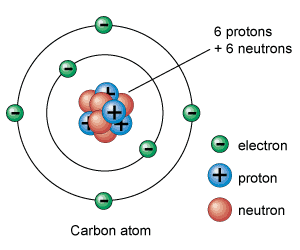
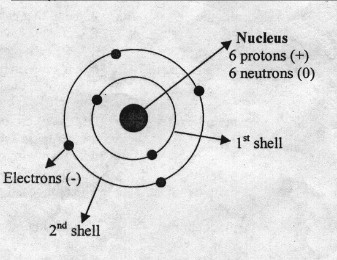
This Carbon atom has a nucleus that contains 6 protons and 6 neutrons. Outside the nucleus, 6 electrons surround the atom.
Every atom has a nucleus with protons and neutrons, and electrons surrounding it.
- Protons are positively charged particles found in the nucleus of an atom.
- Neutrons are neutrally charged particles (No charge), found in the nucleus.
- Electrons are negatively charged particles found around the atom. They are smaller in size than Protons and Neutrons.
The amount of valence electrons an atom has determines how reactive the element is, in what column of the Periodic Table is it in, with what other families of the Periodic Table is is most reactive with etc. As you can observe, valence electrons are important and tell you a lot about an atom. For an atom to be stable, meaning it doesn't need to loose or gain any electrons because it's reactive, the atom needs eight valence electrons. That means it only needs 8 valence electrons in it's outermost shell. Noble gases, column 18 in the Periodic Table, are stable elements because they all have 8 valence electrons, that's why, they are not reactive with other elements and are hard to bond.
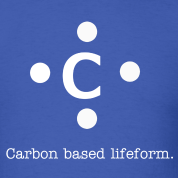
This is a Carbon atom Dot Diagram. A Dot Diagram tells you the amount of valence electrons an atom has. Carbon has 4 valence electrons.
Halogens are in column 17 of the Periodic Table and have 7 valence electrons. To be stable, they only need one more electron and are disposed to gain that electron. In the other hand, Alkali Metals are in column 1 of the Periodic Table and have 1 valence electrons. To be stable they need to loose that one. This means that Alkali Metals are disposed to give away that one electron to become stable. As you can analyze, Halogens are very reactive with Alkali Metals.
